Zero Trust Remote Solution vs. Traditional VPN Remote Solution
In our previous article "Current Status and Trends of Industrial Remote Access in 2026", we mentioned that some enterprises still use traditional VPNs with "full access" vulnerabilities, and also pointed out that "Zero Trust is becoming the industry standard".
So what exactly is wrong with traditional VPNs? And why has Zero Trust remote access become the next-generation solution? In this article, we compare these two solutions from core logic, security capabilities to cost investment, to help you make the right choice.
The Fundamental Difference Between the Two: Web Access vs. Application Access
Before the comparison, it is important to understand that although both traditional VPN and Zero Trust remote access enable remote access, they are two fundamentally different architectures.
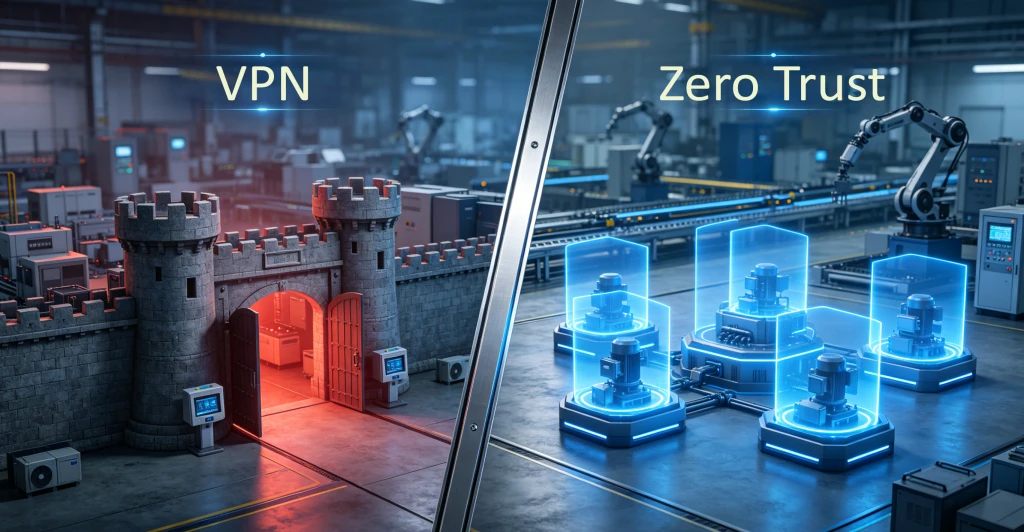
Traditional VPN is based on "perimeter trust" — its core logic is to pull users into the internal network, establish an encrypted tunnel through IPSec or SSL protocols, and assign remote users an internal IP address.
Zero Trust follows the philosophy of "never trust, always verify" — every access request must undergo multiple verifications including identity, device and environment, and users are only granted the minimum permissions required to complete the current task.
Simply put, VPN is like a building access card that controls "which building you can enter", while Zero Trust is like a room key that only allows you to enter "this specific room, and you need to swipe the card every time".
Why Do People Still Use VPNs Despite Their Limitations?
Traditional VPN solutions are not entirely useless. They still have certain advantages in specific scenarios:
Abundant products and mature technology:VPN protocols have been refined for over two decades with a mature product ecosystem.
Suitable for fixed site interconnection:VPN remains a low-cost and highly reliable option for "site-to-site" scenarios between enterprise headquarters and branch offices.
Short-term cost advantage:For small enterprises with limited budgets, the initial investment in a VPN solution is much lower than a full Zero Trust deployment.
However, we believe the core problem with traditional VPNs is not "technology" but "the architecture itself". This architecture was designed in the last century when "internal networks were trusted and external networks were not". Today, in the face of hybrid work, multi-cloud environments and APT attacks, this architectural logic has become outdated.
Zero Trust: Why It Is the Next-Generation Solution?
The core philosophy of Zero Trust is "never trust, always verify". Regardless of whether an access request comes from the company's internal network or a street café, it must undergo strict identity authentication, device health check, permission authorization and behavior monitoring audit. We summarize its advantages into four points.
Advantage 1: Application-level isolation and least privilege authorization
Zero Trust solutions only grant users the minimum access permissions for specific applications/devices, making other internal resources invisible. Moreover, permissions are not assigned once and valid for life. The system can dynamically adjust permissions based on user identity, device status, access time and location.
Advantage 2: Continuous verification and real-time monitoring
Zero Trust solutions typically monitor access behaviors, device status and environmental risks in real time. Once abnormalities are detected, they immediately revoke permissions and block access.
Advantage 3: Significantly reduced attack surface
In a Zero Trust scenario, even if attackers steal employee credentials, they can only access certain authorized applications/devices. This minimizes the attack surface and ensures that a single node compromise will not lead to the collapse of the entire internal network.
Advantage 4: Natively adapted to multi-cloud platform work
Zero Trust solutions do not depend on network location. Security policies are consistently enforced whether in the office, at home or at the airport. They can also be synchronized across platforms, making them more suitable for operation in multi-cloud and hybrid cloud environments.
A Clear Comparison of the Two Solutions
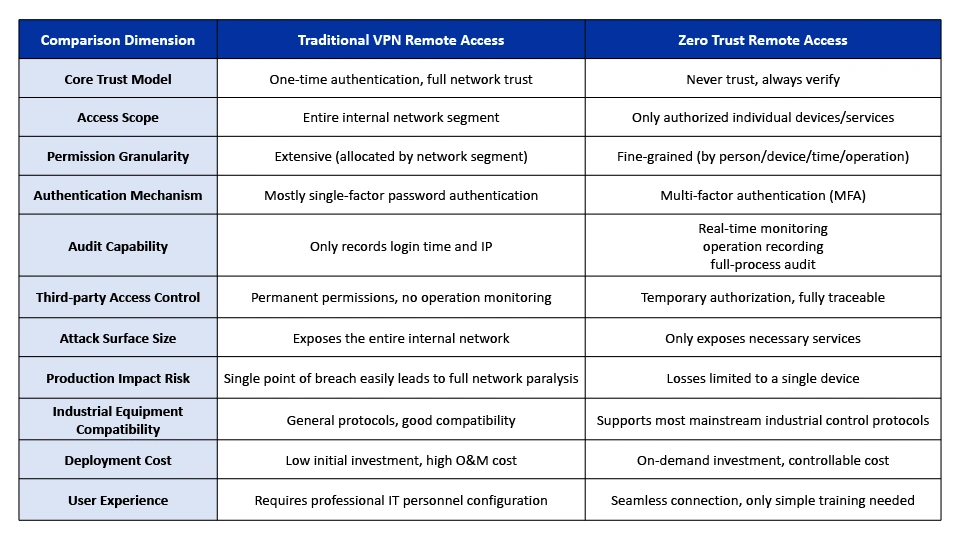
Should You Adopt a Zero Trust Solution?
Back to the most practical question — should your enterprise continue using VPN or switch to Zero Trust? Here is a concise decision framework.
Scenarios Suitable for VPN + Zero Trust Transition
- Small enterprises with simple remote access needs and high security risk tolerance
- Fixed site-to-site network interconnection
- Temporary remote maintenance of non-sensitive systems
Scenarios Recommended to Switch to Zero Trust
- Remote work has become the norm, with employees accessing enterprise resources from multiple locations and devices
- Involves core business systems (ERP, CRM, financial systems, R&D code repositories)
- Has multi-cloud or hybrid cloud architecture
- Requires access from external suppliers or partners
- Operates in industries with compliance requirements (finance, healthcare, government, critical infrastructure)
- Seeking security solutions in industrial environments with OT and IT convergence
If your budget is limited, you do not need to pursue a comprehensive Zero Trust architecture. You can start with the most critical remote access security, choose a SaaS-based Zero Trust solution with pay-as-you-go pricing, such as our AMP. First focus on solving the security issues of third-party O&M and core device access, then gradually cover the entire network.
Zero Trust is not a distant future concept, but an ongoing industry transformation. The only difference is whether you choose to deploy proactively or respond passively after the next security incident. Because essentially, this is not a technical choice, but a risk management decision.